Few things feel more frustrating than having two glasses of wine to "unwind and fall asleep," only to wake up at 3:14 AM with your heart pounding against your ribs, throat parched, and your mind racing through tomorrow's to-do list.
Alcohol is widely treated as an over-the-counter sleep aid, but in neuroscience and sleep medicine, it is recognized as one of the most potent chemical disruptors of natural sleep architecture. While ethanol's sedative properties shorten the time it takes to lose consciousness (sleep latency), sedation is not sleep. In reality, alcohol robs your brain of its most critical restorative phase: Rapid Eye Movement (REM) sleep.
If you have recently stopped drinking or are planning a dry challenge, you might be asking: how long after quitting alcohol does sleep actually improve? Below is the clinical neuroscience behind alcohol's sleep disruption, what to expect night-by-night, and the objective biometric metrics you will see on your wearable device.
| Recovery Phase | Neurochemical & Physiological Shift | What You Experience (Wearables & Mind) |
|---|---|---|
| Nights 1 to 3 | Acute Glutamate Rebound; suppression of synthetic GABA sedation | Longer sleep latency, night sweats, fragmented micro-arousals; brain craves external sedative |
| Nights 4 to 7 | The "REM Rebound" Phase; acetylcholine surge; sympathetic tone decreases | Vivid, cinematic dreams; sleeping resting heart rate (RHR) drops by 4–8 BPM; morning grogginess starts lifting |
| Weeks 2 to 3 | Slow-Wave (Stage 3 NREM) deep sleep stabilization; core body temperature normalizes | Deep sleep percentages climb toward 20–25%; waking up refreshed without needing immediate caffeine |
| Day 30 & Beyond | Complete Circadian Rhythm and Adenosine receptor recalibration | Heart Rate Variability (HRV) peaks at baseline; sustained daytime alertness with zero afternoon brain fog |
The Sedation Paradox: Why Alcohol Feels Like Sleep but Isn't
To understand why sleep feels so broken after drinking, you have to look at the brain's delicate balance between two opposing neurotransmitters:
- GABA (Gamma-Aminobutyric Acid): Your brain's primary inhibitory "brake pedal." Alcohol mimics GABA, binding to GABA-A receptors and rapidly slowing central nervous system activity. This creates the heavy, sedated feeling that makes you pass out quickly.
- Glutamate: Your brain's primary excitatory "gas pedal." Alcohol acts as an NMDA receptor antagonist, actively muffling glutamate signals.
Your brain is an adaptive homeostatic machine. Sensing an overwhelming surge of chemical sedation, it fights back by desensitizing GABA receptors and aggressively manufacturing extra glutamate to keep you alive and breathing. This works fine while ethanol is circulating—but creates chaos the moment your liver finishes metabolizing it.
The Anatomy of the 3:00 AM Wake-Up
A standard adult liver metabolizes ethanol at a steady rate of approximately one standard drink (14 grams of pure alcohol) per hour. If you finish two drinks at 10:30 PM, your Blood Alcohol Concentration (BAC) reaches zero right around 2:30 to 3:30 AM.
How Alcohol Starves Your Brain of REM Sleep
Healthy adult sleep consists of 90-minute ultradian cycles alternating between Non-REM (Stages 1 through 3) and REM sleep. Stage 3 (Slow-Wave Deep Sleep) repairs your physical tissues, muscles, and immune system. REM sleep, on the other hand, is where your brain repairs your mind:
- Emotional Regulation: During REM sleep, stress chemistry (noradrenaline) is shut off while your brain replays difficult emotional memories, stripping away the painful charge. Without adequate REM, you wake up irritable, reactive, and emotionally brittle.
- Memory Consolidation: Information and motor skills learned during the day are transferred from temporary hippocampal storage to long-term cortical networks.
- Neural Waste Clearance: The glymphatic system flushes metabolic waste, including beta-amyloid proteins, from brain tissue.
Even moderate drinking (1–2 drinks) suppresses REM sleep by 24% to 40%. Heavy drinking can suppress REM by up to 80% or eliminate it entirely in the first half of the night. You may "sleep" for eight hours, but biologically, your brain was chemically anesthetized, not restored.
Built into Alcohol Free Tracker
See when your Deep REM Sleep Architecture unlocks
Follow your real-time body repair timeline—from Acute Detox (8h) and GABA/Glutamate Stabilization (72h) to Deep REM Architecture Restoration (7d)—100% private and offline on your iPhone.
Track My Sleep Recovery Free on iOS →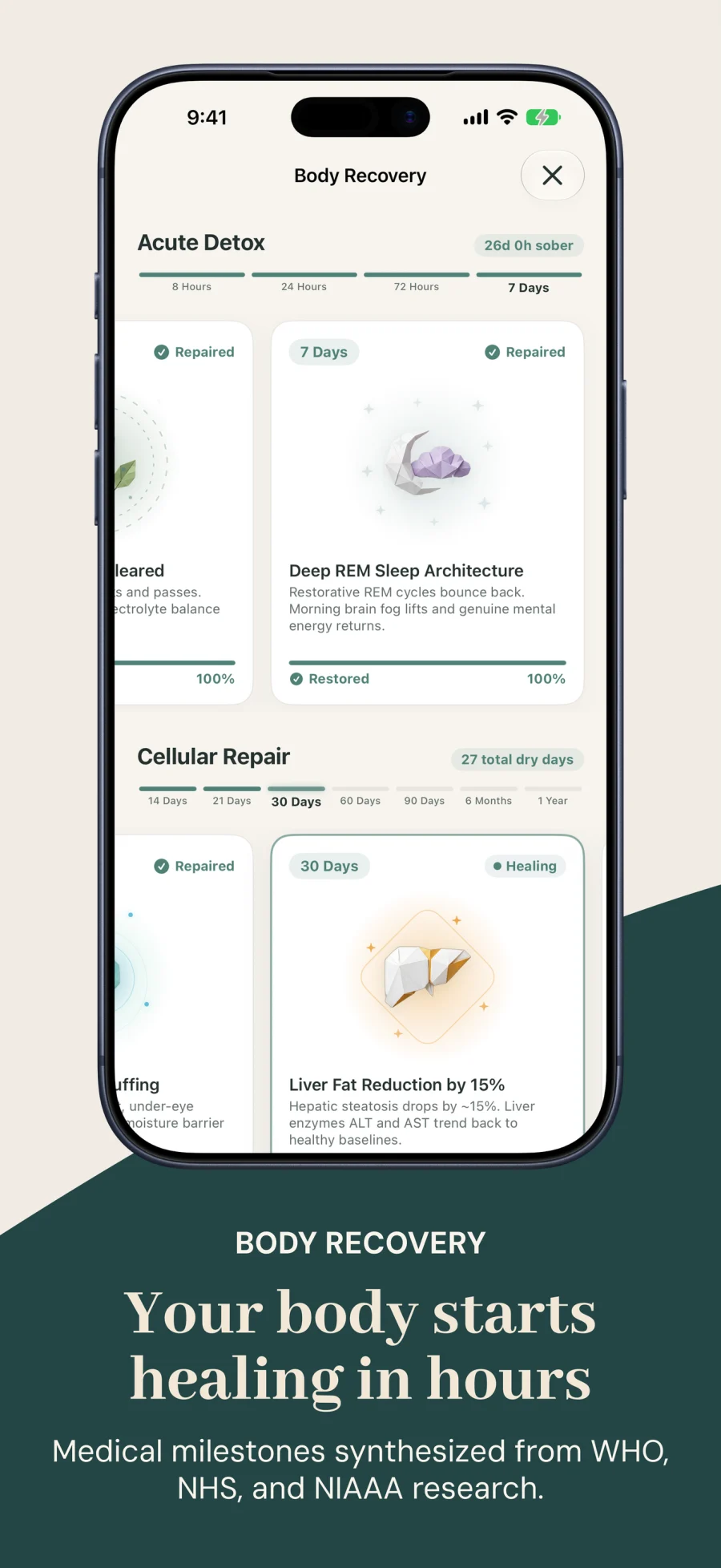
The Night-by-Night Recovery Timeline
Nights 1 to 3: The Acute Reset (Expect Turbulence)
The first few alcohol-free nights are often the hardest. Because your brain grew accustomed to having ethanol perform the heavy lifting of sedation, you may experience longer sleep onset latency (taking 30–60 minutes to drift off), restlessness, and mild night sweats as your body purges lingering metabolic byproducts.
What to remember: This temporary restlessness is not "insomnia"; it is your brain relearning how to produce natural GABA and accumulate adenosine (sleep pressure). Remind yourself that even quiet, eyes-closed rest in a dark room provides meaningful physiological restoration.
Nights 4 to 7: The REM Rebound (Vivid, Cinematic Dreams)
Around Day 4 to Day 7, a fascinating clinical phenomenon occurs: the REM Rebound. Having been starved of rapid eye movement sleep for weeks or months, your brain suddenly plunges into prolonged, intense REM phases as soon as you fall asleep.
- What you experience: Incredibly vivid, detailed, technicolor dreams—sometimes bizarre or emotionally intense. Many people even dream about drinking alcohol (a common "relapse dream" that is simply the brain processing habit circuitry).
- Wearable metrics: Your Apple Watch, Whoop, or Oura Ring will show REM percentages leaping from 10–12% up to 25–35% of total sleep time.
Weeks 2 to 3: Deep Slow-Wave Architecture & RHR Drop
By the second week, sleep continuity stabilizes. The micro-arousals disappear, meaning you sleep uninterrupted for 6 to 8 hours straight. Your autonomic nervous system shifts decisively from chronic sympathetic dominance (fight-or-flight) to parasympathetic recovery (rest-and-digest).
- Sleeping Heart Rate (RHR): In regular drinkers, nighttime resting heart rate often hovers around 68–78 BPM because the cardiovascular system is working overtime to clear toxicity. By Week 2 alcohol-free, RHR typically plummets by 5 to 12 beats per minute, reaching true recovery baselines of 50–60 BPM.
- Heart Rate Variability (HRV): HRV—the gold standard metric of nervous system resilience—often jumps by 20% to 50%.
Day 30 and Beyond: True Circadian Restoration
By Day 30, natural circadian melatonin secretion and cortisol rhythms are completely recalibrated. You will notice waking up naturally before your alarm clock, without the dread of brain fog or requiring three cups of coffee just to feel human. Afternoon energy crashes virtually disappear.
4 Practical Protocols to Accelerate Sleep Recovery
- Anchor Your Suprachiasmatic Nucleus: Get 10–15 minutes of direct morning sunlight in your eyes within 30 minutes of waking. This sets your circadian clock, triggering natural melatonin release 14–16 hours later.
- Manage Evening Cortisol with Urge Surfing: Cravings for an evening drink usually peak between 5:00 PM and 8:00 PM, driven by conditioned stress cues. Neuroscience shows an alcohol urge crests and fades within 3 to 5 minutes if you ride the sensation without reacting.
- Cool Your Sleeping Sanctuary: Alcohol impairs thermoregulation, causing vasodilation and night sweats. Keep your bedroom between 65°F and 68°F (18°C–20°C) to facilitate the core body temperature drop required for deep stage-3 sleep.
- Consider Magnesium Glycinate: 200–400 mg of magnesium glycinate 60 minutes before bed supports natural GABA synthesis and muscle relaxation without causing dependence.