When people contemplate doing Dry January, Sober October, or taking an intentional 30-day break from alcohol, they usually anticipate the physical perks: deeper sleep, less facial puffiness, and mornings free from regret. But within the first two weeks, a completely different realization hits: the sheer amount of unspent cash accumulating in their bank accounts.
Most regular and social drinkers dramatically underestimate how much alcohol actually costs them. We tend to remember the price tag on the grocery receipt or the single $15 cocktail on a Friday night, while conveniently ignoring the ripple effects—the 20% service tips, surge-priced rideshares, late-night greasy takeout, and lost productivity.
So, how much money do you save not drinking for 30 days? The short answer: between $250 and $1,200+, depending on your drinking habits and lifestyle. Below is the exact financial breakdown, including direct drink costs, the hidden "shadow tax," and the thousands of empty calories you keep off your body.
| Drinker Profile | Typical Weekly Drinking Pattern | Estimated 30-Day Cash Saved | Estimated 30-Day Calories Avoided |
|---|---|---|---|
| Moderate At-Home Drinker | 1 bottle of wine every 2 nights or 6-pack craft beer ($35–$60/wk) | $200 – $380 | 4,500 – 7,200 kcal (~1.5–2 lbs fat equivalent) |
| Social Weekend Drinker | 1–2 social nights out (4–6 drinks/night) + tips, Uber & food ($90–$180/wk) | $450 – $850 | 8,000 – 14,000 kcal (~2.5–4 lbs fat equivalent) |
| Daily Wine or Bar Regular | 1–2 bottles wine/night or daily bar tabs with colleagues ($180–$300+/wk) | $800 – $1,400+ | 16,000 – 26,000 kcal (~4.5–7.5 lbs fat equivalent) |
Direct Costs: The Pure Math Behind 30 Days Dry
To see where your money goes, let's look at the three most common alcoholic beverages and how their direct purchase prices compound over four and a half weeks (30 days):
1. The Wine Drinker's Tab
A decent bottle of wine at retail averages $15 to $22. If you share or consume one bottle every evening or two:
- At Home (15 bottles/month): 15 × $18 = $270/month.
- At Restaurants & Wine Bars (2 glasses/outing, 3 times/wk): At $14–$18 per glass plus tax and tip, that is ~$40 per outing, totaling $480 to $600/month.
2. The Craft Beer & Pub Enthusiast
Four-packs of specialty IPAs or craft stouts average $16 to $22 at bottle shops. At local pubs or breweries, a single pint runs $7 to $10 before tip:
- 8 to 12 pints per week: 40 pints across 30 days × $9 (average with tip) = $360/month.
- Adding retail weekend cases brings the average beer spend to $350 – $520/month.
3. The Cocktail & Nightlife Socializer
In metropolitan areas, craft cocktails now standardly cost $16 to $22 each. Add an 18–20% tip and local alcohol tax, and each round for two people easily approaches $45 to $55:
- A modest 2 outings per week with 3 cocktails per night equals 24 cocktails in 30 days.
- 24 × $20 (tax + tip included) = $480 directly on cocktails.
The "Shadow Tax" of Alcohol: Hidden Expenses You Forget to Count
Direct beverage costs represent only about 50% to 60% of the true financial burden of drinking. The secondary financial penalties—what behavioral economists call the "shadow tax"—almost always double the bill:
- Surge Rideshares & Taxis: Taking an Uber or Lyft to and from an evening out averages $25 to $45 each way during peak hours. Eliminating 6 weekend social outings saves $150 to $300 in transit costs alone.
- Late-Night Food Delivery: When alcohol suppresses blood sugar regulation, ghrelin (the hunger hormone) spikes. The 1:00 AM pizza order, kebab run, or DoorDash delivery averages $25 to $40 per incident. Four late-night orders add up to $120 to $160.
- Hangover Recovery Spend: Next-day survival tactics aren't free: cold-pressed juices, large iced lattes, fast-food comfort meals, and grocery delivery to avoid leaving the couch typically drain $40 to $80 per month.
- Impulse Online Shopping: Late-night browsing with lowered inhibitions leads to unvetted purchases on Amazon, eBay, or apparel stores that you would never make at 10:00 AM on a Tuesday.
Built into Alcohol Free Tracker
Calculate your exact cash & drink savings automatically
Set your typical weekly drink spend once. Watch your saved dollars and avoided drinks accumulate in real time down to the hour—100% private on your iPhone with zero account required.
Calculate Your Savings Free on iOS →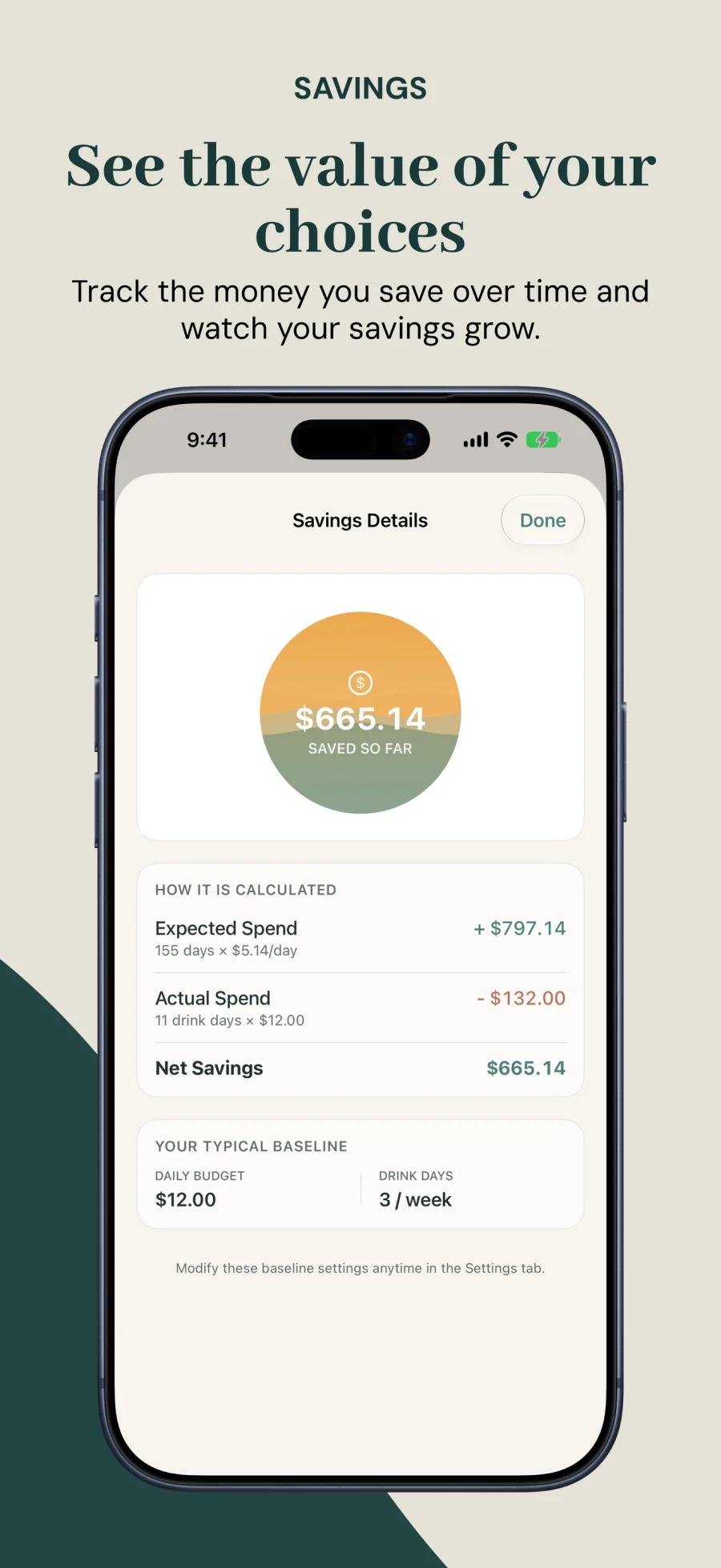
Physical Savings: The Empty Calorie Dividend
Financial savings are tangible, but the biological "savings" are just as dramatic. Alcohol contains 7 empty calories per gram—nearly as calorie-dense as pure dietary fat (9 kcal/g), but with zero vitamins, minerals, protein, or dietary fiber.
Furthermore, because acetate (the byproduct of alcohol metabolism) is a toxic substance, your liver drops all fat-burning operations to prioritize burning off ethanol. Any calories consumed alongside alcohol (bar snacks, burgers, cheese) are immediately shunted into adipose tissue storage.
- Wine (5 oz glass): ~125 kcal. A standard bottle contains ~625 kcal. Skipping 12 bottles in 30 days removes 7,500 empty calories.
- Craft IPA (16 oz can): ~200–260 kcal. Consuming 20 cans a month adds up to 4,800–5,200 kcal.
- Cocktails with syrups/tonics: Often 250–400 kcal per glass. Ten cocktails equal 3,000–4,000 kcal.
Since one pound of human body fat roughly equates to 3,500 calories, avoiding 7,000 to 14,000 empty alcohol calories over 30 days is the metabolic equivalent of shedding 2 to 4 pounds of pure fat—without restricting your nutritious daily meals.
The Compound Wealth Effect: What Happens After 30 Days
A single 30-day reset proves that you can enjoy life, socialize, and decompress without spending hundreds of dollars on liquid sedation. But look at what happens when you turn a 30-day experiment into an ongoing lifestyle of moderation or sobriety:
| Time Horizon | Moderate Savings ($300/mo) | Heavy/Social Savings ($650/mo) | If Invested at 8% Annual Return (S&P 500) |
|---|---|---|---|
| 30 Days | $300 | $650 | Immediate cash cushion in your checking account |
| 6 Months | $1,800 | $3,900 | Fund a high-end vacation or build an emergency fund |
| 1 Year | $3,600 | $7,800 | $3,750 – $8,125 |
| 5 Years | $18,000 | $39,000 | $22,100 – $47,800 |
| 10 Years | $36,000 | $78,000 | $54,800 – $118,700 |
What felt like "just buying a few drinks" over a decade is actually the cash down payment on a home, a fully funded college tuition fund, or an early retirement nest egg.
How to Use Financial Milestones to Protect Your Motivation
Willpower is a finite resource. When an evening craving hits between 5:00 PM and 7:00 PM, reminding yourself of abstract long-term health goals can sometimes feel distant and unconvincing. But financial metrics are immediate, concrete, and deeply satisfying.
- Allocate your savings to a visual goal: Decide beforehand what your 30-day alcohol savings will purchase: a weekend spa getaway, noise-canceling headphones, a new piece of tech, or a deposit into an investment account.
- Track the daily ticker: Watching your saved cash tick upwards every morning gives your dopamine system the tangible, positive feedback loop it craves.
- Gamify the urge: Every time you ride out a 3-minute craving instead of driving to the liquor store or ordering a drink at dinner, mentally credit yourself $15 to $20.
Taking a 30-day break from alcohol is one of the very few personal decisions where your health, mental clarity, and financial net worth all dramatically improve at the exact same time.